





ABSA International Virtual Conference Scholarships
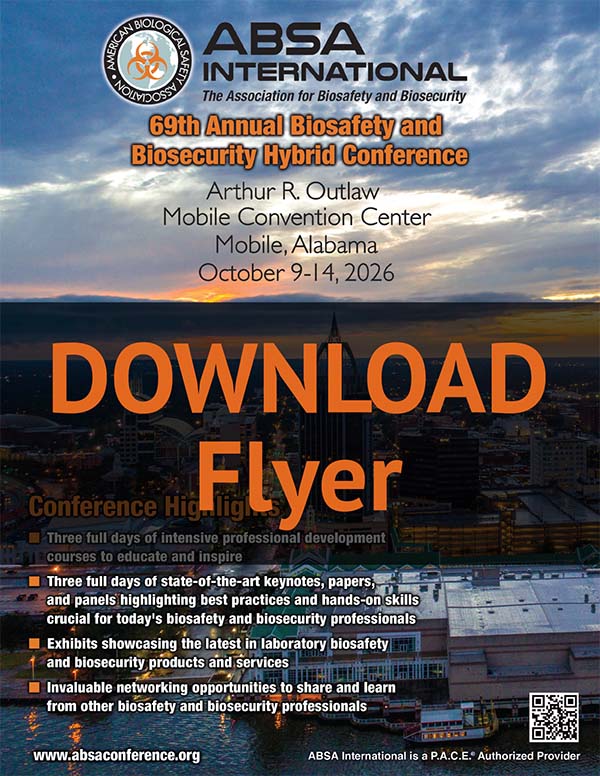
ABSA International is offering up to ten scholarships to members of international affiliates in low-income and lower middle-income countries LMIC to virtually attend the 2026 ABSA International Biosafety and Biosecurity Conference. This initiative aims to enhance professional development, knowledge-sharing, and global biosafety and biosecurity capacity-building by offering opportunities to professionals who might not otherwise have access to this event.
*LMIC is defined by the World Bank as a combination of “low-income economies”, “lower middle-income economies”, and “upper middle-income economies”
Eligibility Criteria
To be eligible for this scholarship, applicants must:
- Be a member in good standing of ABSA International and/or of any ABSA International affiliate and reside in a LMIC as defined by the World Bank.
- Demonstrate job responsibilities that include biosafety or biosecurity (e.g., biosafety officers, biosafety professionals, laboratory managers, research scientists, public health officials, or regulatory professionals).
- Be actively engaged in their affiliate, regional, or local biosafety/biosecurity community, contributing through volunteer work, committee participation, or outreach.
- Be willing to share the knowledge gained from the conference with their affiliate or broader community, either through presentations, written reports, or training sessions.
- Have access to a reliable internet connection sufficient to participate in the virtual conference.
- Applicants should ideally possess a background in life sciences, microbiology, public health, or a related field. Degrees or current enrollment in relevant programs (Bachelor’s, Master’s, or Ph.D.) would be considered.
- Those with other backgrounds may also be eligible if they can demonstrate interest in biosecurity/biosafety through letters of recommendation, job description, or ABSA/IFBA certification.
*LMIC is defined by the World Bank as a combination of “low-income economies”, “lower middle-income economies”, and “upper middle-income economies”
Additional Selection Criteria
To ensure fairness, impact, and diversity, the following additional considerations will be applied:
- Financial need – Preference will be given to individuals without institutional or governmental support for attending professional development events.
- Career stage – Priority will be given to early- and mid-career professionals who would most benefit from the experience and contribute long-term to biosafety and biosecurity.
- Geographic and Institutional Diversity– ABSA International will aim to evenly distribute scholarships across different LMIC regions, biosafety fields, and types of institutions, including public health laboratories, hospitals, veterinary, agriculture, research /academic institutions, and regulatory agencies
- Impact potential – Preference will be given to individuals who can amplify the knowledge gained, such as trainers, educators, policymakers, or professionals involved in regulatory frameworks.
- Previous scholarship recipients– Consideration will be given to whether the applicant has previously received an ABSA International conference scholarship, ensuring opportunities are extended to new participants.
Post-Conference Expectations
Scholarship recipients are required not later than 2 months after the conference to:
- Submit a short impact report (1–2 pages), outlining key takeaways from the conference and how they plan to apply them.
- Engage with ABSA International post-event (survey) to share their insights with the broader community.
- Conduct a knowledge-sharing activity, such as a presentation, training, or summary for their affiliate or institution.
Failure to participate in the virtual conference will result in not being awarded a certificate of attendance or credit points for the event.
Application
Before applying please read the above criteria and expectations carefully and make sure you are ready to submit the following:
- A Short Statement of Interest (maximum 500 words) explaining how the scholarship will support your professional development and your community.
- A brief CV or Resume (maximum 2 pages) highlighting your relevant biosafety/biosecurity experience.
- A maximum of two Letters of Recommendation from an affiliate leader or employer confirming engagement and commitment to the field.
- Proof of recognized certification from ABSA International or IFBA, if applicable.
Selection Criteria / Evaluation & Selection Process
Evaluation & Selection Process
Selection Committee – The International Engagement Committee will review and evaluate applications.
Rubric-Based Evaluation – Applications will be scored based on eligibility, need, and impact potential.
Selection Transparency – A clear process and timeline for application submissions and results will be communicated.
Commitment
Scholarship recipients will be expected to actively participate in the virtual conference. Certificate of attendance will only be awarded to those participants.
Template for rubric based evaluation:
| Criterion | Component | Rating Scale | Description |
| Statement of purpose | Clarity of future goals | 1-5 | 1: Unclear goals, 5: Clearly articulated and specific goals. |
| ABSA International affiliate | Good standing | 1-5 | 1: 5 Years of affiliation |
| LMIC resident | In world bank list | 1-5 | 1: No, 5: Yes |
| Job Responsibilities | Biosafety & Biosecurity percentage of work | 1-5 | 1:15%, 25 %. 50%, 5:75% |
| CV | Relevance of education | 1-5 | 1: Irrelevant education, 5: Highly relevant education. |
| Letter of recommendation | Strength of endorsement | 1-5 | 1: Weak, 5: Strong and enthusiastic endorsement |
| Willingness to share the knowledge | Past experience in knowledge sharing | 1-5 | 1: No relevant experience, 5: Extensive experience in teaching, mentoring, or outreach. |
Diversity and Inclusion:
Ensuring diversity in scholarship recipients, priority will be given considering factors such as gender, geographic location, and background.
One scholarship will be awarded per affiliate.